

Scrolling for the right wall thermostat gets old fast, especially when half the listings assume you already know whether your system runs a heat pump or a conventional furnace. This roundup is built for people who want straightforward, no-drama climate control at a sensible cost. You’ll find a mix of programmable and non-programmable options across single-stage, multi-stage, and heat pump configurations, all from brands that have been quietly making HVAC gear for a long time.
A Fast Comparison Of The Options
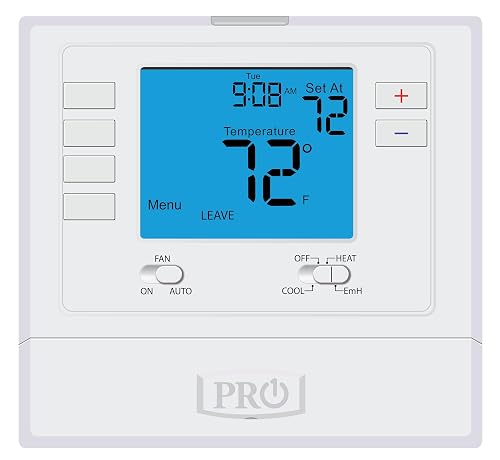
PRO1 T725 Heat Pump/Conventional Programmable Wall Thermostat

PRO1 T771 Single Stage Non-Programmable Wall Thermostat
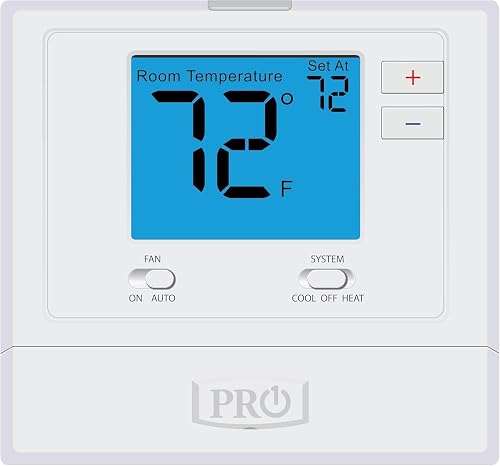
PRO1 T701 Single Stage Non-Programmable Wall Thermostat

PRO1 T715 Multi-Stage Programmable Gas Thermostat
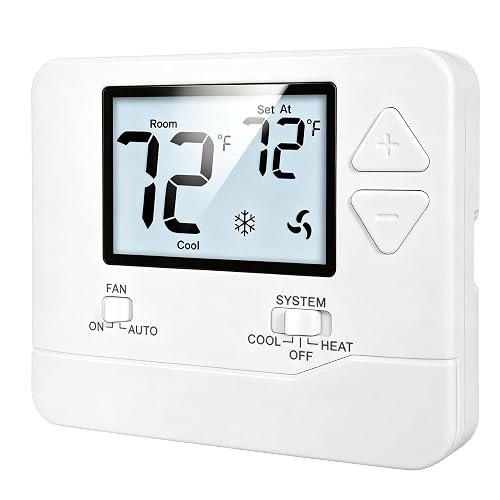
Heagstat NonProgrammable Thermostat 1 Heat/1 Cool
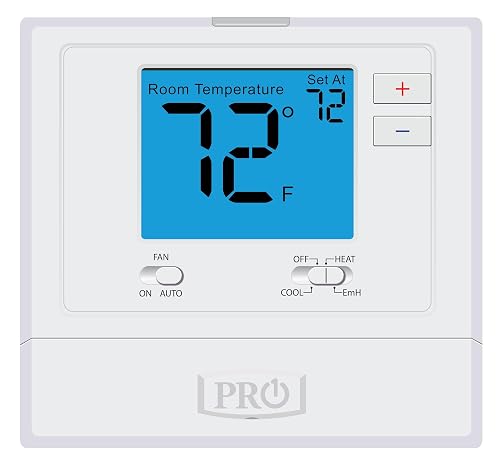
PRO1 T721 Non-Programmable Wall Thermostat

PRO1 T805 Single Stage Programmable Wall Thermostat
More Details On Our Top Picks
Most wall thermostats lock you into one system type, which is exactly the frustration the PRO1 T725 Heat Pump/Conventional Programmable Wall Thermostat sidesteps. It handles 2 heat/1 cool heat pump setups and 1 heat/1 cool conventional systems, with 7-day or 5/1/1 scheduling that lets weekdays, Saturdays, and Sundays each get their own routine. The 4-square-inch blue backlit screen is easy on aging eyes in a dim hallway, and the wake/leave/return/sleep schedule mode covers the four blocks most households actually care about.
Compared to the simpler T701 that follows, the T725 earns its place by offering genuine scheduling instead of a single setpoint. For owners of heat pumps who want weekend and weekday control, it does the work of a much more expensive smart stat without needing an app or a Wi-Fi account.
Benefits That Matter
- Dual compatibility with heat pump and conventional systems removes the guesswork when you don’t know which one is in the wall
- 7-day and 5/1/1 scheduling (a format where weekdays share one block and Saturday and Sunday each get their own) fits shift workers and hybrid schedules
- Four-period programming (wake, leave, return, sleep) covers a full day without constant manual adjustments
- Large blue backlit display stays readable from across a living room in low light
Honest Caveats
- Programming takes a few minutes upfront; expect a learning curve the first time you set the schedule
- Battery or hardwire power options exist, but you’ll want to confirm your existing wiring before installation
Feature Snapshot
Built With In Mind
Heat pump owners who want weekday and weekend schedules without paying smart-thermostat prices.
Where Another Pick Suits Better
For a no-schedule single-stage setup, the PRO1 T701 keeps things simpler and may be a better fit for guest rooms or rentals.
The PRO1 T771 Single Stage Non-Programmable Wall Thermostat is built for spaces where most home thermostats simply give up. Its 25°F to 90°F setpoint range reaches well below the comfort band of a normal living room, which is exactly what you want in a detached garage, a workshop, or a storage shed that needs freeze protection. A 4-square-inch blue backlit display keeps the readout visible, and the swing adjustment plus calibration controls let you fine-tune the temperature swing to match how drafty the room runs.
Where the T725 above brings full scheduling, the T771 strips all of that out and focuses on rugged, set-it-and-walk-away control. For most backyards, that simplicity is a feature, not a compromise.
Notable Upsides
- Wide low-temperature setpoint range protects pipes and pets in unconditioned spaces
- Swing adjustment and calibration help the stat match how the room actually heats and cools
- Non-programmable design means no schedule to reset after a power outage
Things To Consider
- No scheduling means manual setpoint changes whenever the weather shifts
- Single-stage only, so it isn’t a fit for two-stage heating systems
Right Fit For
Garage, shed, or workshop owners who need reliable low-temp control and don’t want to fiddle with schedules.
Consider Something Else When
You want indoor scheduling flexibility; the PRO1 T725 delivers that without the low-temp reach.
The PRO1 T701 Single Stage Non-Programmable Wall Thermostat takes the T700 platform and trims it back to the basics. It’s built for 1 heat/1 cool conventional systems, which covers the majority of gas, oil, and electric furnace setups in single-family homes. The 4-square-inch blue backlit display is roomy enough to glance at from the couch, and a glow-in-the-dark light button means fumbling around in a dark hallway is no longer part of the bedtime routine.
Unlike the T725’s scheduling, the T701 deliberately drops every program. For short-term renters or guest rooms, that simplicity means guests can’t accidentally override a week of carefully tuned settings.
The Upside
- Spacious 4-square-inch display reads clearly across most living rooms
- Glow-in-the-dark light button makes nighttime adjustments painless
- Gas or electric configuration flexibility suits most standard HVAC setups
- Non-programmable design is genuinely tenant-proof
Small Caveats
- No scheduling means you adjust the setpoint manually when seasons change
- Single-stage only, so it won’t run a two-stage furnace optimally
Feature Snapshot
Made For
Rental units, guest rooms, and homeowners who want the simplest possible wall stat without app clutter.
Skip It When
You want automatic setback schedules; the PRO1 T805 brings 7-day programmability to the same conventional system.
Two-stage heating systems need a thermostat that actually understands them, and the PRO1 T715 Multi-Stage Programmable Gas Thermostat was designed with that in mind. It supports 2 heat/2 cool gas systems and offers 7-day, 5/1/1, or non-programmable operation, so it grows with how you use it. The 4-square-inch blue backlit display sits on the larger T700 platform, and a glow-in-the-dark light button helps when you’re adjusting it after dark.
While the T701 above is a clean fit for simple single-stage homes, the T715 steps up to the more demanding two-stage furnaces common in larger or newer houses. The tradeoff shows up when installation gets more involved, but for the right system the comfort gain is meaningful.
A Favorable Mix
- True multi-stage support (2 heat/2 cool) runs modern two-stage gas furnaces as intended
- Three operating modes give you a programmable stat today and a non-programmable one tomorrow if needs change
- Clear backlit display paired with a glow-in-the-dark button covers day and night use
- Battery or hardwire power options simplify retrofit installations
Points To Note
- Multi-stage wiring is more involved than single-stage swaps, and the existing C-wire (a common return wire that powers the thermostat continuously) must be confirmed before purchase
- More settings on screen can feel busy for shoppers who only need basic temperature control
Feature Snapshot
Best Suited To
Owners of two-stage gas furnaces in larger homes who want genuine multi-stage behavior rather than a single-stage approximation.
Look Elsewhere When
You only have a single-stage system; the PRO1 T701 covers that simpler use case for less.
The Heagstat NonProgrammable Thermostat is purpose-built for 24VAC conventional single-stage 1H/1C forced-air systems, which covers a wide range of older and mid-range homes running gas, oil, or electric furnaces paired with a separate air-conditioning condenser. The 2 to 5 wire base fits the most common residential wiring layouts, so it’s an approachable first replacement for a thermostat that has finally given up. The white backlight keeps the screen readable without flooding the room with blue light at night.
Versus the PRO1 T701 in slot three, the Heagstat trades brand familiarity and the larger T700 platform for a tighter feature set aimed squarely at the most common residential wiring. For first-time installers, the simpler wire count often makes the difference between a 10-minute swap and a long Saturday afternoon.
Strengths Worth Knowing
- Two to five wire compatibility covers the bulk of older home wiring without rewiring
- White backlight is easier on the eyes in bedrooms and hallways
- Conventional single-stage focus keeps the install path short
A Few Limitations
- Connections with 6 to 8 wires aren’t supported, so it won’t fit some larger system configurations
- Not compatible with heat pump, multi-stage, or line-voltage systems, so confirm your setup first
- No scheduling means you’ll be turning the dial manually for seasonal changes
Feature Snapshot
Who Should Grab It
First-time installers with a conventional single-stage system and 2 to 5 wires already in the wall.
Reach For A Different Pick When
You have a heat pump; the PRO1 T721 handles 2H/1C heat pump or 1H/1C conventional configurations.
The PRO1 T721 Non-Programmable Wall Thermostat is the quiet workhorse of the lineup, covering 2H/1C heat pump or 1H/1C conventional systems on a single board. That dual-system flexibility matters when the old thermostat has been replaced so many times that no one remembers exactly what’s in the wall. The 4-square-inch blue backlit display and glow-in-the-dark light button come straight from the T700 platform, so the user experience matches the more expensive models in the family. AA battery or hardwire power selection gives you options for retrofit jobs where the C-wire situation is unclear.
Compared to the T771 in slot two, the T721 adds heat pump support while keeping the non-programmable simplicity. For a mixed-system household, it’s the kind of unit you install once and stop thinking about.
Bright Spots
- Heat pump and conventional dual compatibility removes the need to know your system in advance
- Glow-in-the-dark light button is a small but welcome touch for late-night tweaks
- AA battery or hardwire power gives flexibility on retrofit installs
- 4-square-inch display fits the established T700 family look
Factors To Consider
- No scheduling means setpoint changes are manual across the year
- Commonly reported setup quirks on multi-wire retrofits can mean double-checking wire labels
Feature Snapshot
Whose Shelf It Belongs On
Homeowners who want one stat to cover either a heat pump or a conventional system and don’t need app-based scheduling.
A Better Fit Elsewhere
For dedicated garage freeze protection, the PRO1 T771’s wider low-temperature range is a better match.
The PRO1 T805 Single Stage Programmable Wall Thermostat is the one to reach for when screen size matters more than anything else on the spec sheet. Its 7-square-inch blue backlit display is roughly 75 percent larger than the 4-square-inch screens elsewhere in the lineup, which makes a real difference from across a long living room or for anyone with reduced vision. Underneath, the T805 is a 1 heat/1 cool conventional stat with 7-day, 5/1/1, or non-programmable modes, so you can run it like a smart stat or like a simple setpoint unit, your call.
Compared to the T701 three spots up, the T805 trades a slightly bigger install footprint for a much easier-to-read screen and full programmability. In a main living area or wide hallway, that extra real estate is worth it.
Reasons It Performs
- Extra-large 7-square-inch display is readable from across a large room
- Three operating modes let you start with scheduling and switch to manual later
- Glow-in-the-dark light button for nighttime adjustments
- Conventional 1H/1C compatibility suits the most common residential furnace setups
Worth Bearing In Mind
- Larger footprint means you may need a bigger wall plate for a clean retrofit
- Single-stage only, so it won’t run two-stage heating systems optimally
Feature Snapshot
Who Will Love This
Main living areas where a big readout beats compact elegance, especially for anyone with reduced vision.
Swap It Out When
You have a two-stage system; the PRO1 T715 is the right multi-stage pick in this lineup.
What To Weigh Before Choosing Your Next Thermostat
Picking a wall thermostat comes down to three honest questions about the system behind the wall. Answering them up front saves a return trip and the frustration of a stat that doesn’t talk to your furnace.
Know Your System Type And Stages
The first step is identifying whether you have a heat pump, a conventional furnace, or a single-stage setup, and how many heating and cooling stages your equipment supports. A single-stage furnace cycles on at full power, while a two-stage furnace can run at a lower output for milder days, which means smoother temperatures and a quieter home. Buying a single-stage stat for a two-stage system wastes the equipment you already paid for, while buying a multi-stage stat for a single-stage system overspends on capability you’ll never use.
Match The Wiring Before You Match The Features
Most wall thermostats run on low-voltage wire, and the wire count in your wall (typically 2 to 8 conductors) sets the boundary of what will install cleanly. The C-wire, a common return conductor that delivers continuous power to the thermostat, is what allows backlit displays and steady power without batteries. If your existing bundle is 2 to 5 wires, the Heagstat and the T701 cover you without extra work; larger bundles sometimes call for a different base or a pro install.
Programmable Vs Non-Programmable In Real Life
Programmable stats shine for households with predictable weekday and weekend routines, where a 7-day or 5/1/1 schedule can quietly trim heating and cooling costs. Non-programmable stats win for guest rooms, rentals, and spaces where simplicity matters more than automation. The T725 and T805 give you full scheduling, while the T701, T721, and T771 keep the dial-down operation that some households genuinely prefer.
Key Considerations Across These Picks
Pitfalls Shoppers Hit
The most common mistake is buying a thermostat before opening the existing one to count the wires and read the terminal letters. Another is assuming a heat pump setup and a conventional furnace use the same stat, when in fact the wiring and staging logic differ enough that a mismatch can short-cycle your equipment. Always confirm your system type and stage count before picking a model.
Where The Extra Money Goes
Spending more on a programmable or multi-stage stat buys three real things: a larger backlit display, more flexible scheduling, and the ability to run two-stage equipment properly. For a small guest room on a single-stage system, the cheapest reasonable stat does the job. For a large two-story home with a two-stage furnace, the upgrade from a T701-class stat to a T715-class stat translates directly into quieter operation and steadier temperatures.