
Vog settles indoors the way dust settles on a shelf: quietly, then all at once. When volcanic haze drifts in, the goal is fewer fine particles reaching your lungs and a room that doesn’t feel stale. HEPA-grade air purifiers pull those particles out of the air while filters, fan speeds, and smart sensors handle the day-to-day. The list below focuses on models suited to vog conditions: sealed HEPA filtration, real room coverage, and the ability to run for hours on a quiet setting. Each pick fits a different home layout and budget, so you can match a unit to your space rather than the other way around.
The Leading Options At A Glance

DREO Air Purifier for Home DR-HAP009 (Dreo 539)
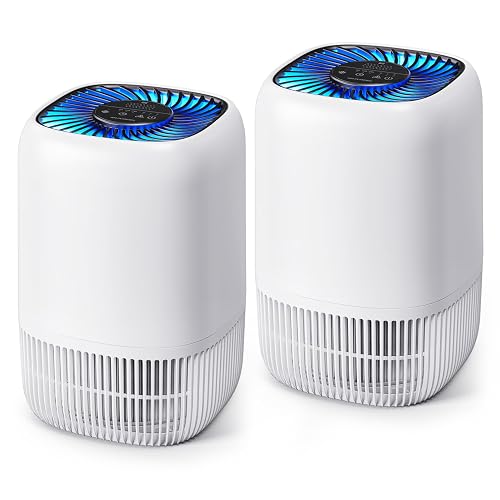
VOOPNU 2-Pack Air Purifier DH-JH12 (White)
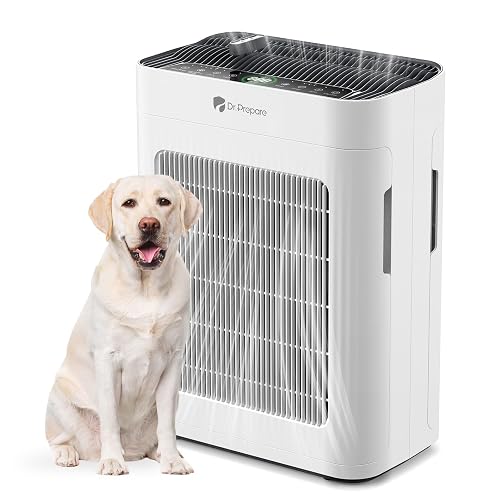
Dr.Prepare Air Purifier for Home Large Room
DREO Air Purifier for Home DR-HAP008 (Dreo 338)
DREO Smart Air Purifier for Home DR-HAP009S (Dreo 539S)
ECOSELF Air Purifier for Home Large Room
Rabbit Air A3 SPA-1000N HEPA Air Purifier (Black)
Inside Each Recommended Option
The DREO DR-HAP009 anchors the list because it pairs a rated Clean Air Delivery Rate of 158 CFM with coverage for rooms up to 1,176 square feet, which matters when vog seeps in through every open window. The PM2.5 monitor reads particle levels in real time, so the Auto Mode can ramp the fan up before you even notice the haze thickening. Four manual speeds round out the controls, and a dedicated Sleep Mode keeps noise down overnight in a bedroom.
Compared with the compact VOOPNU set covered next, this DREO trades footprint for sheer volume, making it a stronger anchor for a living room. Owners who run it on Auto during vog events typically see the PM2.5 number drop within the first hour, depending on room size. The Turbo setting is the loudest mode, so most people save it for quick clears rather than all-day use.
Useful Highlights
- Rated 158 CFM CADR (Clean Air Delivery Rate, the volume of clean air pushed out per minute) handles mid-to-large open spaces without struggling.
- Built-in PM2.5 sensor triggers Auto Mode when haze levels climb, so the unit reacts for you.
- Sleep Mode lowers fan speed and dims indicator lights for overnight bedroom use.
- Four manual speeds give you direct control when Auto Mode overreacts to cooking steam or other brief spikes.
- Cylindrical HEPA filter design pulls air from all sides, helping placement against a wall rather than only in open floor space.
Things To Consider
- The replacement HEPA filter adds an ongoing cost worth budgeting for, especially in a region with frequent vog.
- Turbo Mode is noticeably loud, so it works best for short clearing bursts rather than long daytime operation.
Quick Facts
Who It Suits Best
Homeowners in vog-prone zones with one large central room that needs the most attention during a haze event.
Consider Something Else When
Studio dwellers in tight quarters will get more from the smaller, two-pack VOOPNU DH-JH12 setup covered below.
The VOOPNU 2-Pack flips the usual approach: instead of one big purifier, you get two compact units, each rated at 22 dB on the lowest setting. Place one in the bedroom and one in the home office, and the vog load gets split across rooms rather than fought in a single space. Each unit includes a fragrance sponge and a soft night light, which is a small but useful touch for a nursery or guest room.
The trade-off, of course, is reach. Where the DREO DR-HAP009 covers an open living area, the VOOPNU units shine in tighter spaces under roughly 200 square feet each. The timer function helps in a vog day because you can set one to run for a few hours while you work, then switch to the bedroom unit at night. Filters are replaceable, and most owners stock spares to avoid a gap in coverage.
Real Benefits
- Two units at one price point lets you cover two rooms simultaneously during a vog event.
- Low 22 dB output on the lowest speed keeps the bedroom quiet enough for light sleepers.
- Built-in timer supports scheduled runtime so the unit isn’t left running all day.
- Fragrance sponge slot adds a light scent option if you want to mask any residual outdoor smell during heavy vog days.
Worth Noting
- Each unit targets a small footprint, so a single VOOPNU in a large living room will struggle on heavy haze days.
- Filter replacements come in pairs when running both units, which doubles the long-term maintenance cost.
- Control panels are minimal, so there is no live air-quality readout, just timer and speed.
Made For
Apartment dwellers and remote workers who want quiet background filtration in two specific rooms during vog days.
Look Elsewhere When
Households with a single large great room will be better served by the Dr.Prepare dual-inlet model covered further down.
Dr.Prepare built this model for a different kind of room entirely. The dual-sided air intake pulls from both flanks, which is what lets it claim coverage up to 3,000 square feet. The washable pre-filter is the standout detail: in a vog zone, the pre-filter loads up fast, and being able to rinse it instead of replacing it saves real money over a season of frequent use.
A PM2.5 display sits on the front, paired with a Pet Mode that ramps the fan up when dander or other particles spike. Compared with the DREO 539’s single-side cylindrical intake, this Dr.Prepare moves more total air, but the unit itself is larger and heavier. Plan placement near an outlet and away from foot traffic, since the washable pre-filter still needs occasional rinsing under a faucet.
Notable Gains
- Dual-sided intake moves more air per pass, which shortens the time to clear a heavy vog event in an open layout.
- Washable pre-filter reduces recurring filter costs and helps the main HEPA layer last longer in particle-heavy regions.
- Pet Mode raises fan speed automatically when dander and odor compounds climb, which doubles as a vog-day boost.
- Front-facing PM2.5 readout gives an at-a-glance answer to the question, “is the air actually cleaner now?”
Trade Offs
- The unit is physically large, so small bedrooms or tight corners will feel crowded around it.
- Top fan speeds generate noticeable noise, and a heavy vog day usually means the higher speeds stay engaged longer.
Best Suited To
Homeowners with open floor plans, vaulted living areas, or single spaces that exceed 1,500 square feet in vog country.
A Better Fit Elsewhere
Renters in compact apartments will get more usable coverage from the DREO 338, which is the next option reviewed.
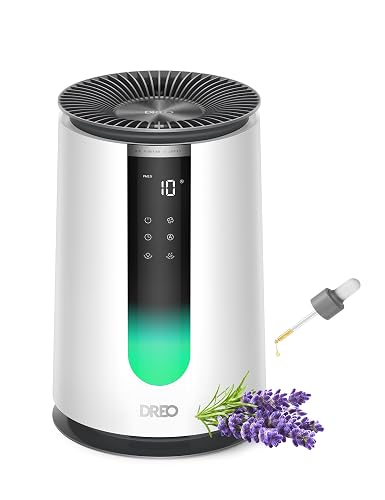
The DREO 338 is the smaller sibling to the 539 covered earlier, with a rated CADR of 115 CFM and a footprint aimed at bedrooms and home offices. It carries AHAM-verified performance, which is the third-party testing standard that confirms the room coverage claim. The PM2.5 monitor and Auto Mode behave the same way as on the larger DREO, just scaled down for tighter spaces.
The Scent Diffuser slot is a small but appreciated addition for homes where vog brings an outdoor smell indoors. The 338 covers up to 178 square feet at four air changes per hour, which is plenty for a typical bedroom. Owners commonly report that the Sleep Mode is the daily workhorse, with higher speeds reserved for the worst days of a vog event.
Features That Help
- AHAM-verified CADR gives you a real tested number to compare against other small-room purifiers.
- Scent Diffuser slot lets you add a few drops of essential oil to mask any vog-related outdoor smell.
- Same Auto Mode logic as the larger DREO 539, so behavior stays predictable if you ever own both.
- Compact body fits on a nightstand, low dresser, or desk without dominating the room.
Minor Gripes
- Coverage drops off sharply past roughly 200 square feet, so it can’t handle a vog-heavy open floor plan on its own.
- Filter replacement is the same shape as the larger 539, so a household running both ends up stocking two filter SKUs.
Who Will Love This
Bedroom-first households and small-space dwellers who want a verified, quiet unit and don’t need large-room reach.
Skip It When
You want whole-home coverage, in which case the Dr.Prepare dual-inlet model reviewed above is the stronger anchor.
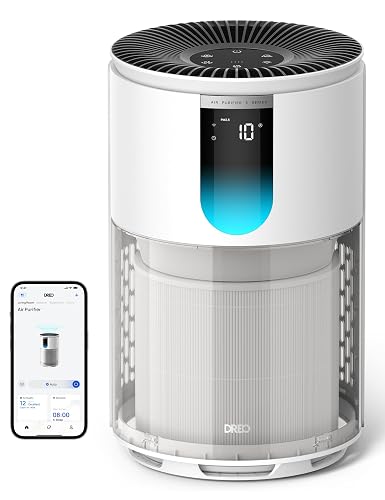
The 539S keeps the same 158 CFM CADR and 1,176-square-foot coverage as the standard 539, then layers in Wi-Fi, voice control, and app integration. The PM2.5 monitor, Auto Mode, and four-speed controls carry over unchanged. The smart layer is what sets it apart: you can check air quality from your phone and bump the fan up before walking into the room.
For a household already running a smart-home setup, this DREO slots in cleanly and removes the “did I leave the purifier on” question. The honest read is that core filtration is identical to the 539, so you’re paying for the connectivity and voice features. In our view, the upgrade earns its place only if you’ll genuinely use the app or voice routines on a regular basis.
Where It Excels
- Identical 158 CFM CADR as the standard 539, so filtration performance isn’t downgraded for the smart features.
- App control surfaces air-quality history, so you can spot vog trends across days rather than just at one moment.
- Voice integration lets you set routines, like bumping fan speed when a haze advisory drops on your phone.
Points To Note
- Higher cost than the non-smart 539, with no change in core airflow or filter design.
- Setup requires Wi-Fi and an account, which adds friction for households that prefer offline-only devices.
Feature Snapshot
Perfect Match For
Smart-home households that want the same DREO 539 airflow with app and voice control layered on top.
Swap It Out When
You’d rather skip the Wi-Fi setup, in which case the standard DREO 539 covered earlier is the more direct pick.
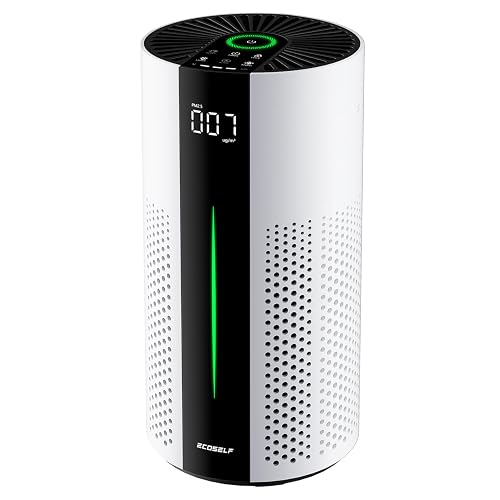
ECOSELF takes a different route to coverage: a 360-degree air intake that pulls from every direction, paired with a rated room reach up to 1,800 square feet. The body is shaped to sit in the middle of a room rather than against a wall, which is unusual for the category. The PM2.5 sensor and Auto Mode work together to step the fan up when vog conditions worsen.
What stood out in the spec sheet is the noise profile, since ECOSELF tunes this model for lower output at higher speeds. Compared with the dual-inlet Dr.Prepare, the ECOSELF trades some raw reach for a quieter daily footprint, which matters in a vog zone where the unit ends up running for days at a stretch. Owners in our view will appreciate the all-direction placement flexibility most.
What Stands Out
- 360-degree intake removes the “which way is the air vent” placement question.
- Rated coverage up to 1,800 ft² covers a large open living area without needing a second unit.
- Auto Mode reacts to PM2.5 shifts, so the unit ramps up on its own when vog arrives.
- Quieter output on higher settings makes long vog-day runs less fatiguing indoors.
Room For Improvement
- 360-degree intake means the unit needs clearance on every side, so wall-hugging is not an option.
- Filter availability is a real consideration: verify the replacement filter SKU before committing, since less common sizes can be slower to ship.
Right Fit For
Open-plan households that want one quiet, central unit running through multi-day vog events.
Another Choice May Suit
You want app and voice control, in which case the DREO 539S is the better-connected pick.
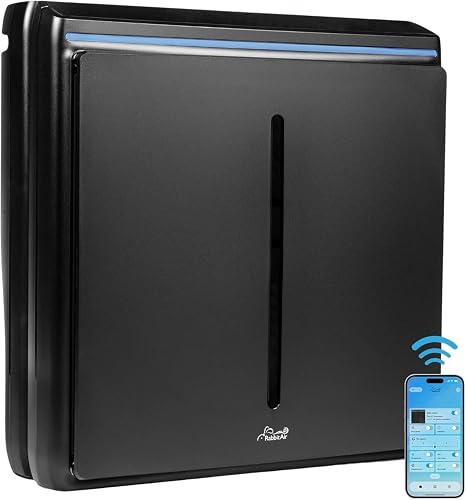
The Rabbit Air A3 is the most configurable unit in this roundup, with a six-stage filtration setup that you can tailor to the specific airborne irritants in your home. The Pet Allergy configuration is the relevant one for vog-prone households with animals, since it adds a stage targeted at dander and odor. At 20.3 dBA on the lowest setting, the A3 is genuinely quiet, which makes it a fit for bedrooms and nurseries.
The trade-off is cost. The A3 sits well above the rest of the list, and replacement filters reflect the multi-stage design. For households where vog coincides with allergy season, the customization is genuinely useful, but a single-condition home will get less from the extra stages. The black finish and wall-mountable design also let it disappear into a room more than most tower purifiers.
What It Does Well
- Six-stage filter customization lets you target the specific mix of particles, dander, and odors in your home.
- Lowest-setting noise of 20.3 dBA keeps it unobtrusive in a bedroom or nursery.
- Wall-mountable design saves floor space in smaller rooms.
- Black finish blends into a room better than the typical white tower look.
Honest Caveats
- Higher upfront cost than any other pick on this list.
- Multi-stage filters cost more to replace, which adds up over a multi-year ownership window.
- Configuration choices can feel like overkill if your home has one main air-quality concern rather than several.
Quick Facts
Whose Shelf It Belongs On
Allergy-prone households in vog zones that want the most configurable, quietest premium option and don’t mind paying for it.
Where A Sibling Pick Shines
Shoppers focused purely on large-room airflow at a lower cost will do better with the Dr.Prepare dual-inlet model.
What Matters Most Before Choosing Air Purifiers for Vog
Real Room Coverage, Not Advertised Square Footage
Manufacturers list a maximum square footage that almost always assumes ceiling height and the cleanest air-change rate. In a vog event, you want a unit that can cycle the air in your actual room four to five times per hour (ACH, or air changes per hour), not the looser one-change-per-hour number used for marketing. Measure your room, check the rated CADR (Clean Air Delivery Rate, measured in cubic feet per minute), and pick the larger size if you’re between two models.
True HEPA Filtration and Sealed Construction
Vog particles are fine, often well under PM2.5 (particulate matter smaller than 2.5 micrometers). A unit with a true HEPA filter is the baseline, and a sealed housing matters more than people expect: air that sneaks around the filter is air that reaches your lungs. Look for models whose filter housing is a single replaceable cartridge rather than loose layers that can gap over time.
Sensor-Driven Auto Mode for Hands-Off Operation
Vog levels shift during the day, so a unit with a PM2.5 sensor and Auto Mode is more useful than one with only manual speeds. The Auto Mode reads the room, decides when to ramp up, and quiets back down when the air clears. It also means you don’t have to babysit the unit when a vog advisory drops unexpectedly.
Long-Term Filter Costs and Replacement Schedule
The sticker price of a purifier is rarely the full cost. Replacement HEPA filters run on a schedule that shortens in heavy-use conditions, and a vog zone counts as heavy use. Before you commit, check that the replacement filter is in stock and reasonably priced, since a great unit with a hard-to-source filter ends up sitting in a closet.
Smart Buying Notes Before You Commit
Mistakes Worth Dodging
Picking a purifier by square footage alone is the most common slip-up, because the advertised maximum is rarely the same as the room you actually need to clean. Buyers also tend to ignore the replacement filter cost, only to find the long-term cost of ownership is much higher than the sticker. A third common miss is placing the unit against a wall or behind furniture, which starves it of airflow and cuts performance sharply, especially in a 360-intake design like the ECOSELF. Measure your room, budget for filters, and give the unit the clearance it needs.
What The Higher Tier Buys
Premium models like the Rabbit Air A3 cost more because they layer in customization, quieter fans, and longer-lasting filter systems. The extra spend shows up in three places: lower noise on the highest settings, a filter design that lasts longer between changes, and housing that holds up to years of daily use. For a single-room, single-concern household, the upgrade is hard to justify. For an allergy-prone home where vog is one of several airborne irritants, the higher tier earns its keep over a multi-year ownership window.
Frequently Asked Questions
Do air purifiers actually help with vog?
Yes. True HEPA filters capture the fine particles that make up most of vog’s irritant load, and a properly sized unit with a working PM2.5 sensor will visibly drop particle readings in a closed room within an hour or two.
How often should I run the purifier during a vog event?
Run it continuously on Auto Mode while vog levels are elevated, then let Auto Mode idle down once outdoor air clears. Continuous low-speed operation is gentler on the filter than repeated high-speed bursts.
What CADR rating do I need for my room?
Match the rated CADR to roughly two-thirds of your room’s square footage for a comfortable margin. A 1,200-square-foot open room usually wants a CADR above 300 CFM for fast clearing, while a 200-square-foot bedroom does fine with 100 to 150 CFM.
How long do HEPA filters last in a vog-heavy region?
Expect filters to need replacement roughly every six to nine months in frequent-use conditions, sometimes sooner if you also have pets. The unit’s filter indicator is the best guide, since real-world load varies with outdoor conditions.
Can I leave the purifier running overnight?
Yes. Sleep Mode or the lowest manual speed is built for overnight use, and the noise on those settings is well below conversation level. Just make sure the room has enough clearance around the intake so the unit isn’t starved for air.
The Takeaway
Match the purifier to the room, not the other way around: large open spaces want reach and CADR, bedrooms want quiet, and vog-heavy regions want a sealed HEPA filter plus a sensor that reacts for you. Any of the seven picks above will earn its place, and the right one depends on the room that needs the most help. Start with the actual square footage, double-check the replacement filter situation, and let Auto Mode handle the rest.